Showing posts with label Analysis. Show all posts

Monday, December 10, 2012

SIX HOURS OF MY LIFE I WILL NEVER GET BACK: THINGS I LEARNED FROM WATCHING THE HOSTEL TRILOGY IN A SINGLE SITTING

There are moments in my life where I make extremely unwise decisions and I will be the last to admit it when I've made a mistake.  However, this is an instance where I will scream from the rooftops how much of an idiot I am.  I'm one of those horror nerds that likes to watch franchises all at once.  When it's Halloween, I'm that asshole that stays inside all day to watch every single Halloween film ever made in a row.  Thanks to the wonderful feature of FEARnet and a hell of a chest cold, my dumbass thought it would be wise to watch all three HOSTEL films, one right after another.  This is the part where my Sassy Gay Friend should pop in and ask me to "look at my life, look at my choices," because this was definitely one of my more idiotic decisions.  I'm not going to sugarcoat it. I hated HOSTEL when it first came out. I really, really hated it. Now before anyone makes a comment about me being a girl or not being able to handle the gore, you can take those stupid comments and put them in your pocket.  I love me some gore, but it needs to have a purpose and it needs to have motivation behind it.  I felt the original HOSTEL was  nothing more than gratuitous violence that rested solely on gross-out factor and provided little to no storyline credibility.  Hoping that maybe Eli Roth could retain some of his Cabin Fever glory in the sequel, I watched that.  I'll be honest, I turned it off about a half hour into  it. I just couldn't do it.  One would think that after that I'd be done with it all but little miss "glass-half-full" over here thought that maybe seeing them all at once would be the better choice.  Boy, was I wrong.  Just like any messy breakup, instead of being upset about all of the wasted time it's important to understand and appreciate the things you learned from the experience.  I submit for approval, the life lessons learned from enduring the HOSTEL trilogy in one sitting.
HOSTEL
Strong concepts can't save a weak movie: If there's one thing I won't deny Eli Roth, it's that he did create a Hell of a creepy concept.  The idea that there are people willing to pay a large sum of money to be a part of a league of violent killers with a penchant for torturing innocent tourists sounds like TAKEN on Walter White strength meth.  Having an interesting idea isn't all a film needs to be successful.  There is little to no tension in the film and all of the violence and killing feels entirely unmotivated.  Now, I understand that half of the charm comes from the "random acts of killing" but this just didn't click right with me.  There just wasn't a fluidity between the storyline and the actions within it. For shame, pussycat.   

Decent acting also cannot save a weak movie: As an actor myself, I am a very picky critic when it comes to acting in a horror film.  I don't think anyone in this film is deserving of any awards for their performances anytime soon, but Jay Hernandez is pretty damn convincing.  At least all of the actors were on the same page with their mediocrity, which gave some sense of continuity within a film that had none elsewhere.  Despite having actors that seemed very committed to the direction they had been given, the film still felt extremely flat and void of any sort of depth.  This could possibly be the terrible writing given for the women in this film.  Can screenwriters please start consulting women before they try to write for them? Eli Roth may have a hell of a female fanbase, but it is blatantly apparent the man has absolutely no clue how to write women.

Your special FX are bad, and you should feel bad: I don't do eye trauma, I don't. It's quite possibly the greatest kryptonite I have.  Upon my first viewing of HOSTEL I distinctly remember having to cover my face and I barely made it through the scene. Upon revisiting, I have no idea what I was so scared of.  One of the most well known scenes from the film has quite possibly the WORST special FX I have ever seen.  When she's screaming in the chair before Paxton cuts off the eye, YOU CAN SEE HER CLOSED EYELID UNDER THE PROSTHETIC. Come on, guys. Get your shit together. That's just basic FX makeup 101. The Achilles tendon cut is pretty good, but the eye scene is one of the worst makeup jobs I've seen in a very long time. Howard Berger, you're better than this.

Roth has absolutely no idea what people really talk like: There is this weird trend going on with filmmakers and having absolutely no idea what teenagers/young 20-somethings actually sound like. HOSTEL doesn't have any lines that are particularly memorable, but Roth slam jams some sarcastic rudeness and tries to play it off as "this is how kids today talk" but the thing is, they don't. They don't talk like how he thinks they do, at all. At 22, I think I'd know. His entire script of dialogue feels entirely forced and trying way too hard to be edgy.  It feels like that kid in the back of everyone's fiction writing class that just HAD to push the envelope if for any other reason than pushing the envelope.  My friends and I have a fair share of conversations that would make even Lisa Lampanelli blush, but Eli Roth must be compensating for something with the amount of dick references he's got sprinkled throughout...It was laughable in a bad way and really hurt the overall atmosphere of the film.  It's okay to be funny, but it's another thing for every single sentence out of someone's mouth to be worthy of upvotes on internet forums.  Good Example of Young Adult Dialogue: Adam Green's FROZEN

HOSTEL II
Eli Roth still has no idea how to write women: There is a reason that Eli Roth hasn't settled down yet, he has no idea what women are all about. Instead of focusing on frat boys like in the first film, Hostel II focuses on three art students who are the stockiest stock characters that ever stock charactered.  I still can't determine if it's because Eli Roth really, truly doesn't understand women, or if he's just a lazy fucking writer.  Two hours of hearing from whiny drunk blonde, overly angsty 'unique' brunette, and desperate wannabe. Heather Matarazzo must have been in a bind for cash, because this was so beneath her.

No one has any idea how much blood is in the human body: One of the misogynist scenes in horror history is the "Elizabeth Bathory" scene and with good reason. It may be (technically speaking) the best shot of the film, but Heather Matarazzo probably has about 3 liters of blood in her entire body, and there is no way she would be spilling this much all over this woman. I was so pissed off watching this scene, and the most misunderstood use of human blood since Johnny Depp's beddeath in Nightmare on Elm Street didn't help the case.

Apparently casting isn't important:  When I'm thinking of terrifying villains, I of course think immediately of Roger Bart.  Um. What? Roger Bart?! THE STRAIGHT NATHAN LANE?! A VILLAIN?! Eli Roth, I know you're not the best at casting (see Rider Strong in Cabin Fever) but this is ridiculous. This man has made a career as a character actor.  I'm all for giving actors opportunities out of type, but casting Roger Bart as a villain is about as convincing as casting Michael Cera as a heartthrob.  Every time he was on screen I was dumbfounded as to how THIS was their best option. Seriously? I just look at him and start singing showtunes.

Gimmicks can be used without reason: I'm sorry. What in the actual fuck was the purpose of putting these little desensitized hellions outside of being 'shocking' or 'edgy'?  Every time these little buggers came on screen I didn't know whether to laugh or scream in frustration.  It's one thing when killer kids have a purpose, but these kids served absolutely no purpose to the film at all. If the scenes including these kids were cut, the film would have lost absolutely nothing, if anything, the film could have benefited from keeping these ridiculously purposeless scenes on the cutting room floor.


HOSTEL III

Weird shit for no reason is a great distraction: Look at this mask. I'm serious. Look at it.  The entire premise of the third installment feels like the series had a baby with the rich people form Rat Race and are now betting in Vegas on the parameters of the deaths of these innocent people.  I kind of dig this concept, but what the hell was the point of this? It's aesthetically impressive, yes, but really distracting. I didn't care about the death scene, all I wanted was a better look at her mask work, which I think was the point all along. This film is garbage, here's a cool mask as a consolation prize.

Sluts are dumb: I am not using the word in an attempt to slut shame, I am using it because that is the stock character all of the women in this film fall into. They're all either escorts or sexually active which is HOLY SHIT SO TABOO in today's modern world.  So when this poor lass is covered with bugs and sweet stuff on her mouth, the slut wouldn't know any better than to close her mouth, would she? Of course not, because for a woman to have any sort of intelligence in any of these films is just too unrealistic. Did I mention she was dressed up like a cheerleader as well? Oh yeah, that happened too.

Victor learned a lot while he was in Europe: One of the more interesting casting choices was Kip Pardue as the villain.  I found it to be a really interesting choice and Pardue really delivered.  Taking the Elite Hunting Club out of their dreary European chambers and into the glamorous world of Las Vegas almost made it a little creepier for me (as an American) to think that this was going on in a place I'd actually visited instead of a location I'll probably avoid like the plague.  It seems that once the film got out of the hands of Eli Roth, things started to improve a little. I mean, a half step up from garbage is still trash, but this could have been a lot worse than it was.

I just saved you six miserable hours. 
You can thank me later.

Wednesday, November 28, 2012

BEN & HARRY: THE IMPORTANCE OF THE MAJOR MEN OF NIGHT OF THE LIVING DEAD

In 1961, a director out of Pittsburgh, Pennsylvania was making his debut with an independent horror film by the title of Night of the Living Dead. Made on a budget of only one hundred and fourteen thousand dollars, George A. Romero’s first installment in his monumental and iconic “Living Dead” series, completely changed the face of the modern horror film and introduced audiences into the basis for the most popular subgenre of horror cinema. Romero’s slow moving, reanimated, undead humans surviving off of eating the flesh of the living became a staple for the modern zombie film and changed the face of undead monsters forever. Night of the Living Dead follows a group of people seeking refuge in an abandoned farmhouse amidst what would appear to be an epidemic where the recently deceased were reanimating, then attacking and eating the flesh of the living. An exposition on the true horrors of humanity as well as introducing a monster that had never been seen before, Night of the Living Dead is one of the most influential horror movies of all time.

Although George A. Romero consistently claims that his casting of Duane Johnson as the African-American protagonist “Ben” was solely based on the actor’s merit and wonderful audition, it would be giving the director a great disservice by not focusing on the importance of a leading African-American character as the main source of salvation, especially in 1968. At this time in America, society was slowly losing grasp on the hopeful ideals of a utopian society in the wake of the Vietnam War. The civil rights movement was growing in full force, but Americans were still hesitant to view African-American citizens on the same plane as their Caucasian counterparts. Ben single-handedly revolutionized the position of African Americans in the horror genre, and potentially, cinema as a whole. As a calm, collected, strong, and cool-headed hero overcoming an attack of not only monsters but also the hysterical antics of the white people surrounding him, Ben was one of the most prominent figures of African Americans in films portraying something outside of a parody or stereotype. Ben does the unthinkable for an African-American man at this time. Ben knocks a frantic white woman out cold, shoots a white man, acts as the voice of reason in the state of chaos, and stands as what would have been the sole survivor (if he hadn’t been mistaken for a ghoul and shot by a white militia). While it may be uncomfortable to address these issues in 2012 with an increasingly more welcoming attitude towards minority groups, the importance of Ben’s position cannot be ignored.

Throughout the course of the film, Harry Cooper is the antitheses of Ben’s character. Harry is distrusting, frantic, stubborn, selfish, and white. Harry was a strong symbol for the “old school” view of most of America at this time. A racist white man hiding out in the basement, Harry was a coward that used bullying and threatening actions as a means to achieve his wants. The older generations in 1968 were living amongst a growing youth of flower children fighting back the government and welcoming change at every turn. The old school disposition was hesitant to follow suit with their younger counterparts, and Harry Cooper is a shining beacon of that mentality.

One scene in particular, is the altercation between Ben and the Caucasian antagonist of the film, fellow refugee Harry Cooper. After a botched attempt for the two young adults trying to escape the ghouls by vehicle, Ben finds himself trapped outside the house after failing to save them. Harry Cooper and his family are the only ones inside the locked house, and Ben remains on the front porch trying to get in while fighting off the horde of the undead. Harry could easily open the door, but he stands hesitant in the opening of the cellar door with the option of either aiding in Ben’s safety, or letting him die. Ben frantically pummels himself into the doorway until finally kicking the door open. At a moment of change in character, Harry Cooper runs to the door to help Ben barricade it shut. Once the door is nailed shut, Ben immediately turns on Harry and begins to punch him numerous times before throwing him into an armchair and threatening to throw him to the ghouls.
 This scene may have appeared to be nothing more than a cowardly man locking out another, but when analyzed further, it represents society’s attitudes towards change as a whole. Most of the initial shots of Harry show him in shadowed lighting while Ben is almost always in full light. It was as if Ben was the white light and Harry was left in the darkness. Harry and his family represent the traditional standards for the American family as set up by the ruling white class. The Cooper family remains within the home, a place of comfort, safety, and white familiarity. Outside of the confines of the home contained a world of potential danger, the unknown, and an African American man. When Ben kicks the door in, he’s a personification of the new changes that were happening to society whether or not the ruling white class was prepared for it. Ben is reality. He was a force to be reckoned with and his advancements weren’t going to be stopped.

Following Ben’s initial emergence, Harry is seen hiding in the doorway to the cellar. Harry had the choice between helping to keep out the monsters outside, or running even further downstairs into the cellar. The cellar would have solidified Harry’s desire for familiarity, but he reluctantly helps Ben nail the door shut. It can be interpreted that Harry had a change of heart when deciding to nail the door shut, but it could also be analyzed that his only motivation for barricading the door was to further protect himself and keep out the unknown. However, when Ben and Harry both nail the door closed, it symbolized that regardless of differences, the two were going to have to work together in order for things to move smoothly and to keep themselves protected. Once order was restored and Ben began to hit Harry, he was literally giving the old school mentality a reality slap. The terrors of the societal changes happening in 1968 were difficult for many of the older generations to handle and it wasn’t until the changes were forced upon them that they began to try and accept them. These cultural advancements needed to come with a heavy hand otherwise these changes wouldn’t have come at all.

Monday, November 26, 2012

LOOK WHAT YOUR BROTHER DID TO THE DOOR: A LOOK AT THE IDEOLOGY OF THE PHYSICALLY AND MENTALLY DISABLED IN THE TEXAS CHAIN SAW MASSACRE

Hi, have you missed me?  I'll spare the gritty details of why my absence has been exactly one month, but in short, MAMA'S BEEN BUSY! I took a well needed break and I'm feeling better than ever.  Which means more fun for you :) Earlier today I posted on my instagram the cover photo for a paper I wrote for my film class on the ideology ideology of the physically and mentally disabled in The Texas Chain Saw Masscare . Well, apparently you fools want to read it.  I've modified the original content just a tad so it'll read less like an academic article and more like a BJ-C blog entry, but without further ado, THE IDEOLOGY OF THE PHYSICALLY AND MENTALLY DISABLED IN THE TEXAS CHAIN SAW MASSACRE!!

Hailing from the desert plains of Texas, a college professor and documentary cameraman by the name of Tobe Hooper was dabbling with independent films, while attempting to wrangle up a crew for a feature film of his own. Alongside writing partner Kim Henkel and comprised predominately of college professors and local students, Hooper armed himself with an estimated $60,000 budget and created one of the most iconic horror films of all time, The Texas Chain Saw Massacre. Following the story of Sally Hardesty, her brother Franklin, their friend Jerry, their friend Pam, and Pam’s boyfriend Kirk, the audience is shown a look into flower children on a road trip across the state in hopes of visiting a home from Sally and Franklin’s childhood as well as investigating a recent grave robbing.  Why anyone would desire to visit a dead body impaled through the asshole by a gravestone is beyond me, but the '70s were a weird fucking era.  The youngsters living in an era before picking up strangers from the road was seen as strange take it upon themselves to pick up a mysterious hitchhiker along their journey who turns violent, erratic, and then forces the troupe to stop along their trip just to deal with his insanity. Who would have thought picking up a sweaty stranger with weird jewelry and a camera dangling off his neck was going to be anything but sane.  After a bit more of a drive, the “Van Family” as they are called, comes across the old house and later on, the Leatherface family residing just next door.

Taking place towards the end of the Vietnam War, the film acts as subtle commentary on the current socio-political climate as well as an exploitation in an immense amount of ideologies of American culture. Arguably, it is the emergence of disabled characters in cinema that acts as one of the most overlooked attribute of the film's importance. Before 1974, mentally and physically handicapped individuals were few and far between on the silver screen, but The Texas Chain Saw Massacre showcases a physically handicapped man and a family of seemingly mentally handicapped individuals. For those grateful enough to live without any sort of physical or mental handicaps, it can be difficult at times to understand or have the proper know how in terms of existing around the disabled. To put it simply, we're some pretty politically incorrect assholes who stare at the disabled or make off-handed comments.  TCM exploits the human’s tendency to treat those with physical handicaps with pity or condolences while greeting the mentally disabled with fear, hostility, and judgment.

The character of Franklin Hardesty is immediately pinpointed as the outcast of the “Van Family”. Surrounded by thin, conventionally attractive flower children, Franklin is overweight, sweaty, temperamental, and paralyzed from the waist down. It becomes rather obvious that Franklin is a black sheep and is to be treated as such. When the Van Family picks up the mysterious hitchhiker, Franklin is the first one to be mistreated on the van. His inability to escape due to the confines of his chair cause the audience to feel a sense of sympathy for him and his condition. Individuals that are physically capable and able to escape if placed in a similar scenario watch this scene without the levity of taking their ability to run away for granted. This severs any connection to the emotional struggle needed to understand and interpret the motives of how each character is interpreted, regardless of their motives. In later scenes, Franklin is shown struggling with entering the home due to the poor traction of the wheelchair, or needing the aide of Sally to push him through the forest in order to escape the dangers that lie ahead. Instead of feeling scared or worried for the well being of his character, audiences instead are geared to feel pity towards his situation.

Audiences know from the beginning that his wheelchair is going to be responsible for his decline, (due to the limited mobility and the struggle of wheeling around the rough terrain) and because of that, we no longer fear for his safety but rather look down upon him for being doomed from the start. Unfortunately, this state of mind seems to be one that is frequently instilled within human psyche regardless of time period. Tobe Hooper utilizes Franklin's condition to garner and molest the notions and misconceptions that we as a society feel towards the handicapped. Is Franklin's physical limitations a result of his demise or not? It's not the act of examining these shortcomings but rather a needed reflection as a whole of why we view this as any reason to segregate this character from any other victim.

In contrast to the physical disability of Franklin, The Leatherface family is often attributed to some form of mental illness as a means to explain their murderous and cannibalistic tendencies. Without further dissection, it is vital that it is mentioned that there is a very strong possibility that the Leatherface family is without any sort of mental disability at all. The progeny of the Leatherface family live as male descendents of a character known only as “Grandpa”. As the patriarch of the household, all of the men born into this family line have been raised from birth to be relentless killing machines. A life of manipulation, death, and destruction is the only way of life these individuals know. Without divulging into far more rooted arguments of nature vs. nurture, let it be known that criminal actions do not equate mental illness. Whether or not the Leatherface family was suffering from a mental illness is irrelevant, because to the victims in the film, they associated their actions with that of a “crazy” person and reacted to them in response to that assumption. During the ‘dinner party,’ Sally screams in terror "You’re crazy,” something that audiences watching the films more than likely agreed with. This statement alone is the sole proof of the way the audience views the Leatherface family. Mental disabilities are highly misunderstood and the actions it causes those suffering with the disability to perform are often so different than that of “normal” society that it invokes an uncontrollable sense of fear in those that are without the mental disability. Sally makes her panicked assumption of the mental state of mind of the Leatherface family in a frantic, screaming, and traumatic situation. From the very beginning, the Van family treats those that behave even the slightest inkling outside of “normal” with hostility and cruelty. Is it that we as society value our physical capabilities over our mental capacities, or is it that we truly fear what the human mind is capable of causing the body to do? Regardless of the answer to this question, the ideology of the way society handles those with handicaps is reflected as clear as crystal in The Texas Chain Saw Massacre.  Crazy should be handled with hostility and even starting to sit and think of the reasoning behind the "insane" actions is simply a waste.
Once Sally has escaped the traumatic events, she is shown in her final scenes in a state of manic laughter.  Has she survived? Yes. At what cost? That is the real question.  In a world of overly political correctness, it's difficult to swallow the behaviors shown in films of yesteryear.  What audiences NEED to understand is a sense of context, and to accept that films are a product of their time.  While using racial slurs or derogatory language towards specific minority groups would be deemed improper in today's film world, our views towards those suffering from physical and mental disabilities appears not to have changed.  It may be difficult to grasp, but by simply taking a look back at The Texas Chain Saw Massacre, we as a society can be forced to look dead on at how slowly we've evolved in terms of sensitivity to the disabled.

Monday, September 10, 2012

THE PLIGHT OF PLATINUM: THE IMPORTANCE OF BLONDE WOMEN IN CLASSIC HORROR

"Blondes make the best victims. They're like virgin snow that shows up the bloody footprints." 
— Alfred Hitchcock

To be a person of virtue, one must possess the characteristics of being morally just and kind-hearted.  It is rather easy to determine whether or not a person is virtuous based on interactions with them, but to be able to convey cinematically that a person is of virtue, it unfortunately must be expressed through the way an actor or actress looks.  In the world of the early horror films, filmmakers did not have the luxury of time to develop the personalities and backstories of secondary characters.  Filmmakers were to generate a tale of a monster to scare the masses, and quite honestly, couldn't be bothered finding time to explain why the damsel in distress was worth anything other than eye candy and something for a monster to desire. The color white has often been associated with purity with everything from the garments warned by angels or the virginal appearance of a wedding gown, but in the years of early horror films, female characters were almost always blonde.  Now, before I continue on any further, I need to address an issue that is bound to flood the comment section.  Unfortunately, classic horror films did not feature many characters of minority descent, and especially did not feature them in leading roles.  That being said, please note that this article is merely a dissection of the importance of the portrayal of blonde women in classic horror films.  This isn't to say that the blondes were better actors or options, but merely artistic choices that have developed stigmas in films that are present even today.

Mary Philbin in The Man Who Laughs played the angelic and blind darling, Dea, the beauty in this "beauty and the beast-esque" horror tale.  While audiences remembered her as a brunette Christine Daae in The Phantom of the Opera it was her role in TMWL that she is most remembered for.  With porcelain skin and tresses that almost illuminated her appearance, Dea was the epitome of a pure, virtuous character.  Without even speaking a single line, audiences knew that Dea was a sweet, loving, innocent, and admirable woman.  The contrast of her snow-like features to the very dark shadows of Gwynplaine, the man with the forever smile was incredibly drastic, and audiences ate her up.  It was this moment that classic horror fell in love with blondes, and created a trend that would follow for decades to come.

Only three years later would horror again return with an etherial female lead.  Helen Chandler (a natural blonde) played Mina, the romantic victim interest of the monster who spawned a million movies, Dracula.  Mina was a character portrayed to be ultimately good, but also the ideal victim to Count Dracula.  The man had a handful of wives but there was something about Ms. Mina Harker he found himself drawn to.  Her blonde hair aided in letting audiences know not only that she was of pure regard, but that she was also the woman we were to pay attention to.  While Dracula was dressed in dark colors and wore darker makeup than most of the female actresses, Mina Harker was dressed in the color of moonlight to compliment the blonde hair adorning her head.  Heather Chandler was a very well known stage and film actress at this point, but choosing her as the lead was no accident. Many may argue the fact Chandler was a blonde is merely coincidental, but Dracula was the Universal monster movie that started the horror movie obsession and set the bar for the abundance of horror films created in the wake of its success. While The Hunchback of Notre Dame is cited as the first Universal monster film, it was Dracula that really got the ball rolling.

It has been said that once something happens three times, it is no longer coincidence, it's preference.  Witness Mae Clarke as the bride in Frankenstein.  Although she changed her hair color and styles frequently over the years, her decision to go blonde in 1925 inspired Anita Loos to create a character named Lorelei Lee for her novel Gentleman Prefer Blondes. Mae Clarke donned a white wedding gown and very light clothing styles for a majority of the film, but it is the scene in which Frankenstein's monster invades her room in preparation for her wedding that really set the blonde damsel into motion.  The extreme contrast of the elegant, white, blonde, woman stranded alone with the very dark, gloomy, brunette monster immediately allowed audiences to fear for her survival.  This isn't solely based on the fact she was trapped with a monster, but her blonde and light attributes gave the impression that she was not only an at-risk civilian, but also that she was innocent and very vulnerable.  


Quickly after Frankenstein, Boris Karloff donned monster makeup again as The Mummy.  Now, this is where the female lead throws a wrench into the formula.  The lead actress was Zita Johann, a brunette.  However, The Mummy is much like The Hunchback of Notre Dame in which the setting is to be an "exotic" land.  The 1920's-1930's was a time in which American audiences had a strong fear and sense of skepticism for those "foreign" to their country.  The All-American look was quickly becoming blonde haired, blue eyed women, and anything outside of this standard was viewed as different and therefore, fearful.  Another important aspect to remember is that unlike Count Dracula, Frankenstein's monster, and Gwynplaine: The Man Who Laughs- the Mummy was wrapped in very light garments.  The female lead needs to contrast to this and the only real option was to have a brunette actress.  Her hair color was used not to showcase her innocence or purity, but rather her exoticism and resemblance to an egyptian princess.  The same could be said to the leading lady of The Creature From The Black Lagoon.  Kay Lawrence was beautiful, yes, but she was in no way a damsel character. She breaks the mold, because her character doesn't fit the bill of the previous female leads in classic horror films.  Not only that, but the film was taking place in the Amazon, an exotic location.  (If we really must split hairs, the woman donned a white bathing suit for the most iconic scenes).

Much like their male counterparts, the female monster was nearly ALWAYS a dark featured, raven-haired beauty.  The Bride of Frankenstein, Dracula's Daughter, and Vampira emerged as horrifying female monsters armed with terrifying qualities and sex appeal that could turn any man into a puddle of what he once was.  Sex appeal was always an important aspect of horror, but unlike the blonde counterparts that were generated as virgins sprinkled with angel dust, the brunette monster was a lustful demoness with the ability to completely take down any man with a bat of an eyelash and a swivel of a hip.  Blondes definitely possessed sex appeal, but that's all they had.  There was no fear factor, just a pretty face to sympathize with.

It would appear that during the early days, the blonde female lead was the go-to for the damsel in distress archetype.  One of the most important factors in this reasoning is due solely on lack of color in films.  When you're dealing with literally fifty shades of gray, filmmakers didn't have much to choose from in terms of creating contrast.  Blondes, they just had to be it.  It wasn't until Alfred Hitchcock emerged as the filmmaking casanova he was with his infamous Icy Blondes, that toe-headed ladies were seen as anything more than the romantic and innocent survival darlings.  Hitchcock didn't follow any of the formulaic horror standards and completely changed the look of the genre.  Blondes were no longer the ideal candidate for the love interest, they were now the easiest targets for destruction.  Fast forward out of the days of black and white films and we are presented with a new type of blonde. The dumb blonde/slut/bitch character.  Damsels in distress were often seen as weak characters, and their only value to society was their beautiful outer appearances.  As the audience's views of women and the way female characters were written evolved, so did the blonde archetype.  The modern blonde woman only good for her looks now became sexually promiscuous, and the damsel unable to defend herself became a ditz.  Being instilled in the early days of film as the preferred look, blondes also developed into self-righteous bitches, generating the "evil blondes".

Even though they were all being massacred, blondes were still the preferred look.  Brunettes had emerged as the virginal final girls, surviving the killer with their pure hearts.  Blondes were still idolized and desired and no longer living in the sexually repressed times of the 1920's and 1930's, blondes were sexually lusted for and were the ones having sex.  Obviously brunettes were having sex too, but final girls instilled the idea that blondes were better than brunettes because they could get laid...but they were also going to be the first to die.  Obviously there are always exceptions to the rule, but this analysis is focusing on the status quo.  As the blonde female character changed, this in turn, forced the brunette to turn as well.  They've seemed to switch places, although the switching is sourced within their original portrayals of classic horror.  Female roles have continued to adapt and evolve and thanks to Buffy the Vampire Slayer, yes, even blondes can be badass monster killers.  The blonde haired women of classic horror have helped to determine the way that blondes are portrayed in films today, and arguably, the way they are continually perceived in society.  And red heads?  Well, they're an enigma all their own and considering they don't have souls...I'm not even going to touch on those weirdos :)

Monday, June 18, 2012

FEED ME: AN ANALYSIS OF THE USE OF FOOD IN HORROR FILMS

Food has always played a vital role in Life's rituals. The breaking of the bread, the last meal of the condemned man, and this meal. However informal it might appear, you can be sure that there was to be little, bonhommie. -The Rocky Horror Picture Show

 Horror films exploit the things we fear not only by the use of the horrifying creatures of our imaginations, but also at the most basic levels.  Films like Frozen exploit the fear of being stranded, fear of being frozen, fear of heights, and fear of helplessness, while films like Psycho showcase the fear of showering, new surroundings, and strangers.  Everyday occurrences that we often look at meaningless activities are quickly turned into something only our nightmares would think to torture us with.  Tapping into our psyches with the things we not only enjoy, but require for survival and twisting them into horrific scenarios tend to be some of the most memorable.  Arguably one of the most well known examples is the way horror films have dealt with food.  Where romantic comedies have an instant connection to flowers and chocolates, horror movies seem to have an instant connection to blood and breasts.  While it is undoubtedly a fact that horror films contain a plethora of mammaries and vein goo, one of the more common factors of our beloved genre is located a little lower than our spurting arteries.  That's right, the quickest way to a horror fan's heart isn't with a blade...it's with a feast.

One of the more obvious ways horror has haunted our dietary dreams is with altering what was actually IN our food.  Charlton Heston's famous discovery of the ingredients of Soylent Green made freaky food horror films a staple in science fiction films.  What made the film so scary wasn't the events that took place or the suspicious activity by those involved it was the reveal of what Soylent Green contained.  To discover that the only something that could keep you alive contained the remains of your loved ones is quite possibly one of the most horrifying discoveries in science fiction history and therefore brought to light our fear of being fed the unknown.  

Larry Cohen has always been a strange bird when it came to his directing choices, and The Stuff was no different.  As an ice cream aficionado, The Stuff has always been a difficult story to swallow.  Differing from Soylent Green which was used for civilians to survive, "the stuff" was a luxury food item, a new product without calories that was as sweet and creamy as ice cream.  I'm sorry, but if someone promised me an item like that, I'd be all over it.  In a world where we're constantly being shelled out new food fads one after the other, films like The Stuff completely tap into the fear that what we're eating...very well may be eating us.  See also: Killer Tomatoes From Outer Space.

To take it a step further and more in your face, leave it up to Lloyd Kaufman to deliver the freaky food flick Poultrygeist: Night of the Chicken Dead.  More of a satire on the fast food industry through the eyes of a horror film, Poultrygeist used the American's addiction to fast food to show the horrifying side effects that Super Size Me never got a chance to experience.  If the health centers and their war on obesity want to really strike some fear into us carnivores, they should really take the Troma approach because I have honestly been a little weary of any sort of fast food chicken since seeing the film.  I'm serious, it's that tromatizing.

In many instances, the food itself isn't what scares us, it's the idea of being eaten.  Dating all the way back to Nosferatu and Count Dracula, vampires were really the first to experience eating people in a sense with their blood lust.  The vampire bite is arguably one of the most recognizable wounds in horror history and although they may not be "eating" us, they are drinking us, which is equally as horrifying.   Hannibal Lecter may not have been the first cannibal, but he easily became the staple of man eating anti-heroes.  Cannibalism is pretty self explanatory when it comes to why it's scary, so I'm not going to waste any more time insulting your intelligence trying to explain why you'd be freaked out if someone on bath salts came bum rushing after you in the nude.  On that same coin, I'm not going to go on and on about why zombies are important because they feed on human flesh.  If you're ill informed about the fear factor of zombies and cannibals...you're on the wrong blog, kid.

Not only is Hitchcock one of the most respected directors in film history regardless of genre, but he was a genius when it came to using food as a plot device in his films.  Hitchcock used food as a tool so many times in his films, two French women compiled a cookbook centered around all of the meals in his films.  My personal favorite (and I'm sure one of yours) is when Janet Leigh barely touches her toast as Norman expresses his relationship with his mother and his thoughts about the meaning of life in his room of taxidermy. For two solid minutes she holds a piece of toast and never moves it lower than it's initial placement other than to her lips.  The tension the audience develops between her uneasiness with her final meal while listening to the banter of Norman Bates.

The scratching of plates, the sounds of swallowing, and the echos of bodies digesting food is a critical tool used to set the tone and mood of the situation.  The silent dinner is a commonly used scenario, but it's when a happy and joyous dining experience is interrupted that catches the audience off guard and helps generate a more powerful scare.  Look no further than the infamous "chestburster" scene from Alien.  The gang seems to be laughing along before the choking sounds and bodily convulsions interrupt the happiness only to have dessert be a giant try of sprinting alien baby.  One of the more unsettling scenes in Poltergeist is when diner is being prepared like any other day and the slab of meat begins to move on its own.  If those aren't ways to destroy an appetite, I don't know what is.

Then there's the idea of intentionally being fed food that is meant for our demise.  The set up is always the same whether it's The Rocky Horror Picture Show,  2001 Maniacs, Whatever Happened to Baby Jane?, or even Serial Mom.  An unsuspecting individual is given a meal on a silver platter beneath a beautifully polished cloche only to be removed and a disgusting or terrifying dish is laying underneath.  Sometimes we're delivered the heads of our loved ones or sometimes we're delivered rats by our insane sisters, but there's something about not being able to see underneath the cloche that only adds to the suspense of figuring out just what the hell we're being served up for dinner.  It's a classic horror freak out and even if there's nothing scary underneath it, the audience almost always develops a sense of nervousness as the character's hand slowly lifts the top off of the tray.

The lack of food, or starvation is another fear many of us will hopefully never have to endure, but something that is very, very real.  While horror movies aren't going to start focusing on our poverty crisis anytime soon, they have found many ways to give us the heebie jeebies at the thought of losing one of our most basic needs.  In the film Dread, a vegetarian character is locked in a room with raw meat simply to see how long it will take her before she finally cracks and eats it.  Watching the poor girl hide in the corners from the meat until her carnal instincts to feed take over was one of the more gut wrenching scenes and it was a very realistic portrayal of the human's response to hunger.

On the other hand, overeating is also an easy go-too for freak outs in films.  One of the more obvious examples is the victim of Gluttony in deadly sin crime-thriller Se7en.  The poor bastard went all Orson Welles and ate himself to death.  The same way we all waited for Violet Bauregaurde to pop in Willy Wonka & The Chocolate Factory, we were all filled with the same sensation after watching Brenda fill up with alien baby slugs in Slither.  From the second we were shown her gargantuan body, every single person was eagerly awaiting her inevitable pop...and boy was it ever a blow out.


Of course I'm going to be missing plenty more examples and this is in no way a definitive analysis.  Please feel free to discuss more examples and situations in the comment section and don't miss out on the conversations that occur over on the Day of the Woman facebook page.

Sunday, April 22, 2012

HOW NON HORROR AUDIENCES AT THE CABIN IN THE WOODS HAVE PROVEN HORROR NEEDS A FACELIFT

HI: 
THIS CONTAINS MILD SPOILERS FOR 
THE CABIN IN THE WOODS. 
YOU HAVE BEEN WARNED. 

The horror world has been doing nothing but gleam about the little darling that is The Cabin In The Woods, and with good reason. (I also need to point out that anytime I say the title of the film, I sing this song.) It's no doubt that this film is undeniably the best mainstream horror film to come out in nearly a decade, and has shot up to horror fans' top ten lists with a raging force.  My good pal Johnny over at Freddy In Space has been doing a bang up job of covering and analyzing everything associated with the film, and I think that before you divulge into my rambling, his opinion is well worth checking out.  Anyway, back to the point of this article.  There have been tons of reviews flying around all of the media outlets, but they're all written by three different types of people.  Horror journalists, general film critics, and hyperactive teenagers with an internet access would appear to be the major voices when it comes to reviewing this film.  Now I'm not discounting any of these opinions, but when it comes to determining the success or failure of something that is determined solely by opinion...we must take into account those that are unbiased.  Horror fans are undoubtedly going to geek out over this film because it was a fanboy fantasy delivered on a silver fucking platter.  What about the non-horror folk? Doesn't their ticket money matter as well?
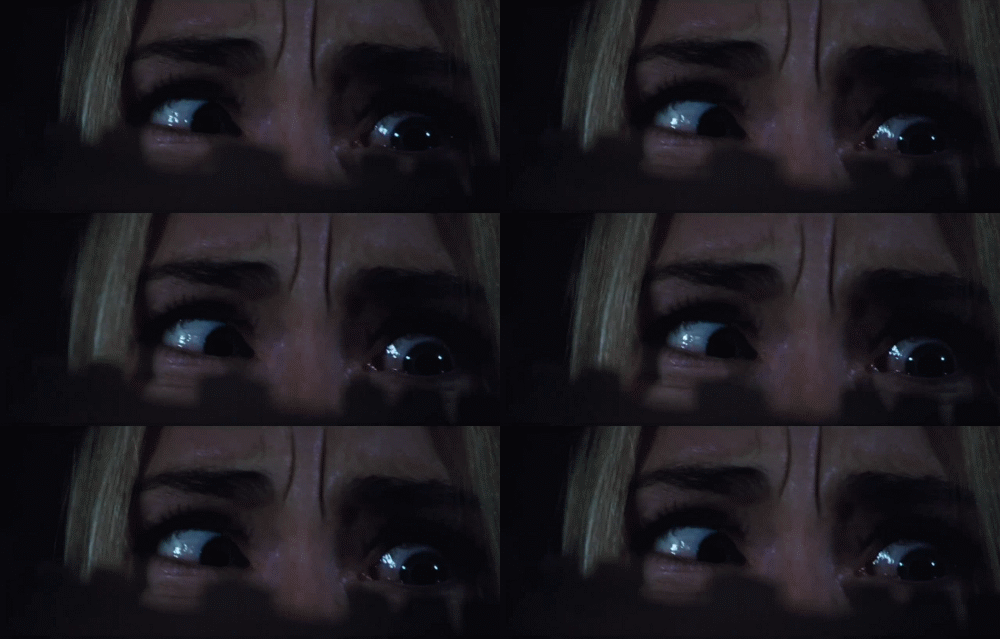
As much as I'd like to believe that the sole purpose of horror films being made is to present something to appeal to the fan, we all know it's a load of poppycock.  Films (regardless of genre) HAVE TO MAKE MONEY.  You could have the best horror film in the world but if only horror fans like it, it is going to flop. Plain and simple. Film companies thrive off of those date night ticket stubs, and the "too young to drink, so what else are we going to do" aged young adults with minimum wage jobs but Mom and Dad still paying for their survival.  That my friends, is a FACT.

Tonight I was lucky to experience something that most of my horror bretheren aren't as lucky to endure.  Horror fans are a breed of their own and we tend to stick to our own kind when it comes to satisfying our livelihood's horrific desires.  However, I've got a best friend I met back during my bitchin' child beauty pageant days that was willing to venture off into the depths of the sticky floored cinema under the pretenses that I'm showing her something that will scare the tan lines right off of her hips.  I have to say, mission accomplished.  As much as I had great joy feeling her jump out of her skin and watch as her hands shifted from squeezing the arm chair to covering her mouth in pure disbelief, I learned more from watching her reactions than I did from the film itself.  Everyone keeps talking about how this movie is so "original".  Okay, yeah, TCITW is original in comparison to the remake craze Hollywood seems to be on, but TCITW is the furthest thing from original.  All it did was pull a SCREAM/Behind The Mask and get super meta with a twist (one that wasn't even reserved for the ending).  Now. That being said. Here's a few things I learned from watching the reactions of a non-horror buff.

I) MUSIC HAS GOTTEN TOO PREDICTABLE:  Everyone knows that half of the battle of establishing fear is creating the atmosphere.  Psychology has proven that we associate what we hear with what we believe is a present danger.  For example: there's a reason that we know the shark is going to attack in JAWS, that Michael Myers is just around the corner in Halloween, that there are stab wounds occurring in the shower during Psycho, or the lack of sound while the body floats in Resident Evil triggering us to expect it to move.  Music is an extremely powerful entity and horror is quite possibly the king when it comes to utilizing and exploiting that power.  That being said, we're beating the same dead horse over and over and over again.  Knowing where all of the "jump scares" were going to happen in this film, it gave me the opportunity to people watch and giggle at the impending shocks they all seemingly knew were coming (even if they weren't).  Just because the strings began to crescendo and hit fermatas on the higher notes, the entire audience began to cringe.  It's almost Pavlovian at how we've all been conditioned to react to violins in horror movies. Granted, I understand that the reason we use this formula is because it works, but maybe we should experiment a bit and figure out another way to use sound to our advantage.  The use of Vassy's "Desire" during Jules' drunken cabin dance in front of the fire was arguably my favorite use.  The bass line pumped from an exterior shot of the cabin and resembled somewhat of a frantic heartbeat.  It immediately put me on edge as well as the rest of the audience, and the sigh of relief that came over when we realized she was merely dancing was a satisfying payoff.  I would gladly enjoy seeing more of that.


II) WEAPONRY NEEDS TO STEP UP ITS GAME: This one isn't even a criticism of The Cabin In The Woods, it's actually a HUGE compliment to it.  One of the initial thoughts that Zach Shildwachter and I shared after our viewing was how incredible the use of the bear trap on a chain was as far as a weapon.  It instills enough terror as bear traps are horrifying on their own, but to hook it to a chain and be able to use it like a damn lasso is one of the most genius concepts I've seen in a long while.  I had assumed that this was just going to excite a horror junkie after witnessing year after year of knife wielding madmen, but it would appear that non-horror fans crave unique instruments of torture as much as we do.  I am probably going to regret making this statement due to my hatred of the franchise, but I cannot deny the reality of SAW changing the face of modern horror.  SAW is arguably the most successful horror franchise of recent years and horror audiences have either spent the last decade in a womb of torture horror or growing up with torture horror reigning as the status quo.  To put it bluntly, knives and axes just don't do it for us anymore.  However, the simplicity of a one motion weapon still seems to have the prowess.  Audiences like the quickness of the knife, but the terrifying originality of a SAW trap.  Therefore, hearing two separate and VERY difference audiences audibly respond with "...is that a fucking bear trap on a chain?!" further proved this thought.  While the Chicago audience of horror nerds on opening night wailed in delight towards the weapon, the cornfield Macomb, IL audience was struck with fear upon its first strike.  Leslie Vernon also had the right idea with a scythe, and that film was also pretty damn well received.  Sensing the pattern?

III) ZOMBIES CAN SLOW DOWN: I'm not against running zombies or anything (okay, maybe I am) but I've noticed that whenever a movie features running zombies, there's a good chance that they're running will be utilized for bad camera work or jump scares.  Slow moving zombies have always been effective because they creep up on you, not jump at you without ever giving you a chance to run.  Running zombies give a cheap thrill while slower moving zombies have time to fester underneath you and put you in a constant state of paranoia.  When Marty stood outside the cabin as Patience Buckner hobbled her one-armed ass out of the forest and towards him, there was an audible reaction from the audience wanting him to go back inside.  Those sort of scenes cannot exist with fast moving zombies because they'd be heard.  That goes back to the predictable music argument.  Marty turned around because he "thought" he heard something, but Patience had wandered into the shadows and he couldn't see her.  Running (true) zombies do not allow for suspenseful scenarios because they'll be too easy to see and hear.  Now, films like ...28 days later have found ways to use quick "zombies/infected" but we must also accept that a good portion of their screen time is used to jump out and spit blood all over someone or with a quick attack.  Audiences attention spans may be slipping, so the goal is to keep them on their toes with quality, creepy, continuous moments, not bombard them with jump scares.


IV) WE CAN STOP DUMBING DOWN DIALOGUE: I don't know what Joe-Blo Hollywood exec. decided that the only people watching movies have the IQ of a lima bean, but we need to stop treating the dialogue in horror films like junior high banter.  Do you want to know which jokes in this film got the biggest laughs? The ones that required actual cognitive process.  Of course there were some chuckles with the stoner jokes, but the pop culture references and intellectual dick jokes got the strongest reactions.  I want a T-Shirt with "husband's buldge" written on it.  They could have very easily said "erection" or "boner" BUT THEY DIDN'T.  They used a terminology that fit for the time of the diary and was still wildly entertaining.  I even heard audience members during the reading of the Latin using their high school semester of Spanish class skills to figure out what he was saying.  Audiences aren't nearly as idiotic as we'd like to believe, and they're clearly happy when the filmmaker never insults their intelligence.  Seriously, if I see one more zombie movie where the characters have no idea what to do with them, I'm going to snap.  They're characters, yes, but they're still human beings capable of understanding the world around them.  It's the 21st century, if you think characters haven't heard "aim for the head" once in their life, you're a damn fool.

V) ENVIRONMENTAL CHANGES ARE A GOOD THING: This is going back to the short attention span thing, changing the environment every once in a while is a good thing.  Give the audiences something else to look at, and DEFINITELY change the lighting.  My movie date was discussing how much she enjoyed the contrasting scenes between the facility and the cabin, as it gave her time to process and wonder.  By changing settings (especially in the manner in which Cabin does by showing bits of the other setting in the background) it gives the audience a conflicting state of mind in that they want to pay attention to what is in front of them, but they are driven mad with wonder as to what is going on in the other setting.  By having layers to the storyline, it keeps the audience engaged to more than just what they're being spoon fed.  Audiences can think for themselves and the DO have imaginations...let them play.

VI) COLOR INSIDE THE LINES: While there are plenty of things that could use a change, the most important thing is that we remember our roots.  There's a difference between being predictable and sticking to the rivers and the lakes that you're used to.  This film exposed the formulaic existence of horror films BUT presented them in an entirely different manner.  Whedon knew exactly how to tickle our fancy with just enough of a meta factor to entertain us but with enough variety to keep us from getting bored.  It's like having a twist ending, but without the poor execution and dissatisfying results.  My movie date kept trying to ask me what was going to happen next and thought she had it all figured out within the first fifteen minutes (including the death order) but LOVED when she was proven only half-right and the other half was from a completely different ballpark all together.  THIS IS WHAT WE NEED.  Stop trying to do something uber new or uber unique because chances are you're going to end up with a different for different's sake style of film that will have the aura of a pretentious collegiate liberal arts piece.  FIND A BALANCE BETWEEN NEW AND OLD.  Or just go old, vintage never goes out of style (I'm looking at you Ti West). 

Wednesday, October 19, 2011

WHAT MAKES A GOOD HORROR MOVIE?

A number of horror movies have been released as of late to panned reviews from critics and low box office numbers.  It has been suggested that mainstream horror has lost its way and it seems as if we're only another remake away from destroying any cinematic credibility we once had.  This is focusing solely on mainstream horror for simplicity's sake.  If I were to open the can of worms and include indie/underground films/films with limited releases, we'd be splitting hairs.  Regardless, mainstream horror has been perpetually insulting not only genre fans, but audiences for far too long and it's gotten a little out of control.  So, I pose this question-what makes a good horror movie?  We sit here and talk about how horror films are going downhill, and yet we aren't making any arguments as to how to fix something.  If you are going to complain about a problem, make sure you have an answer to fix the dilemma.  With help from those that gave input through the Day of the Woman facebook page, here's a base on what it is that makes a good horror film. 
ATMOSPHERE
Within five minutes of posing the question on facebook, I was overwhelmed with requests that a good horror film contain "atmosphere".  When a horror film rests on the instant gratification of a jump scare, it doesn't allow the audience member to slip themselves into the world of the film.  Bertolt Brecht made a name for himself creating performances that were made specifically to distance the audience from what was on stage.  While this practice may work for certain art forms, horror films are not one of them.  If you want a horror film to truly invade the consciousness of an audience and show its strength through standing hairs and goosebumps, the atmosphere is going to play a pivotal role in the success of creating fear.
PLOT
One of the main attributes that horror films appear to be omitting is a strong plot.  It appears that most horror films are being created with the sole purpose to shock or frighten, and the storyline holding the film together seems to receive the least amount of focus.  While a killer, monster, madman, or event can be terrifying, it will be hindered dramatically if there isn't a plot to support the actions.  Thanks to M. Night Shyamalan, horror films have also been placing a greater emphasis on developing an impacting ending, rather than a concise vision throughout the entire duration.  This is leaving the audience without a feeling of fulfillment and irritation caused by the holes left behind.  
ACTORS THAT CAN ACT
As a student finishing up a degree in theatre performance, there is nothing more disappointing than sitting through a horror film and knowing an actor/actress was cast purely on their appearance or their reputation rather than their talent.  Horror films are notorious for giving many well known performers their "big break" or their first chance at a feature film, and yet it has only been as of late that we've been seeing more and more people pop up in horror films that shouldn't have ever made it past an audition reel.  We've focused so much of our energy into their physical appearance which only works in the realm of one-sheets and promotional material.  If you want a successful film, you need talented performers.  I hate to say it, but sometimes...people really are just a pretty face.
SCORE
Underscoring has been proven to either make or break an experience.  The sounds of screaming violins and breathing in the darkness have haunted the nightmares of movie goers for as long as sound has been implemented into film.  The score of a horror film is one of the most fundamental components of a production and yet one of the most overlooked.  Mainstream horror films have seemed to make it their goal to incorporate popular music into their scenes in order to create a more identifiable experience for audience members seeing it directly after the release, but that unfortunately goes out the window once the film is no longer the flavor of the week.  There have been far too many instances in which I've watched a mainstream film from the 1990's and was completely thrown off by the music choices.  However, the score for a film like Suspiria or Psycho will remain timeless and will continue to frighten audiences regardless of generation. 
PACING
If I have to be the one to say it, I will.  Horror films today are moving far too fast.  There's a popular theory that drama moves slowly, comedy moves quickly, and horror movies slowly but finishes quickly.  Insert "that's what she said" jokes as you please.  We has humans have been forced into this hustle and bustle way of life and our horror films have begun to follow suit.  If anything, we need to slow the films down if only to contrast to the way that we function.  If we slow the films down, it will help to create an unusual experience for the audience as it will be a way of moving that we aren't used to.  Filmmakers are often times unsure on how to pace a film and then the payoff hasn't been worth the ride.  You have to pace yourself with everything in this world, (running, relationships, sex, eating)  and this includes films.  
A BALANCE OF BLOOD AND GORE
For the love of all things holy, can we PLEASE stop making films with gore for gore's sake?  Seriously.  Just because a filmmaker decides to blow half of the budget on buckets of blood or gets a little trigger happy with CGI, that doesn't mean a good horror film is going to come from it.  Eli Roth and the SAW franchise are perfect examples of how concentrating too hard on gore can cause the overall film quality to suffer.  Seriously.  I'll take a bloodless film over a sixty-five person human centipede any day. 
BELIEVABILITY
Now, listen to me with care when I say that believability doesn't necessarily mean realistic.  Many classic horror films with fantastic (meaning fantasy, not "cool") aspects of the world around that are still able to remain believable are frequently the films that appear to be the most chilling.  If an audience member is equipped with the tools to subject themselves to the world of the film, the experience will then become all the more horrifying.  If the film isn't believable, the audience member will no longer be able to relate to the situation at hand, and therefore will more than likely find a way to avoid the intended fear. 


NOTE: I am in no way all knowing, this is purely opinion based.  Feel free to add your suggestions in the comment section of this article
Related Posts Plugin for WordPress, Blogger...